
News
Press & Stories
Scroll Down
[News] 2025 Forum on Thermal Break Technology for Carbon-Neutral Buildings Held
- DATE 2026.07.10

As Korean buildings rapidly transition toward high levels of insulation and airtightness, thermal bridging within the building envelope has emerged as a major factor reducing energy performance. Thermal bridges not only cause energy loss but can also lead to condensation, mold growth, and damage to structural materials. Accordingly, the need for structural thermal break technology to systematically address these problems is receiving increasing attention.
Against this backdrop, the 2025 Forum on the Advancement of Thermal Break Technology for Carbon-Neutral Buildings was held on November 28. The event was hosted by the Carbon-Neutral Architecture Institute of the Architectural Institute of Korea and organized by the Building Performance Institute.
The forum provided an opportunity to share the performance and application cases of thermal break technologies, examine the limitations of current design and construction standards, and explore future policy and technological improvements through collaboration among academia, industry, and technical organizations. Participants agreed that, as the impact of thermal bridging continues to grow, establishing more precise standards and expanding the application of relevant technologies will be essential to achieving carbon neutrality.
The first session featured the following presentations:
△ An introduction to thermal break technology by building energy assessor Sang-hee Ahn
△ Strategies for reducing building energy loss and achieving carbon neutrality through thermal bridge control by Tae-gu Lee, Director of the Carbon-Neutral Architecture Institute of the Architectural Institute of Korea
△ Directions for the institutionalization of thermal break technology by Bo-kyung Koo, Senior Researcher at the Korea Institute of Civil Engineering and Building Technology
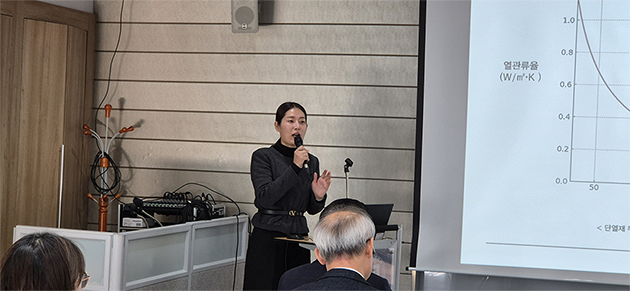
▲ 안상희 건축물에너지평가사의 열교차단 기술 소개
Building energy assessor Sang-hee Ahn emphasized the importance of thermal break technology, stating, “Simply increasing insulation thickness has limitations when it comes to reducing energy loss.” He also highlighted the concentration of heat loss at projecting structural elements such as balconies, slabs, and parapets.
“For high-performance buildings, thermal break technology must be considered from the initial design stage to effectively prevent thermal bridging,” he added.

▲ 이태구 대한건축학회 탄소중립건축원장의 열교 제어를 통한 건물에너지 손실 저감과 탄소중립 실현 전략 소개
Director Tae-gu Lee cited various studies showing that thermal bridging can reduce insulation performance by up to 40%, increase overall energy consumption by up to 30%, and raise heating energy use by as much as 67%.
He also noted that thermal bridging can cause not only building-related problems such as condensation, mold growth, and corrosion of structural materials, but also health issues including respiratory and cardiovascular diseases. To address these risks, he emphasized the need for thermal break technology, along with precise design and rigorous construction management.

▲ 구보경 한국건설기술연구원 수석의 열교차단 기술의 제도화 방향 발표
Senior Researcher Bo-kyung Koo explained that the current ECO2 program applies uniform heat loss coefficients of 0.15 W/㎡·K for interior insulation and 0.10 W/㎡·K for exterior insulation, making it difficult to adequately reflect the actual effects of thermal bridging.
She proposed reviewing more realistic correction values, such as 0.24 W/㎡·K for interior insulation, 0.12 W/㎡·K for exterior insulation, and 0.05 W/㎡·K when exterior insulation is combined with a structural thermal break product. She also emphasized the importance of establishing building-envelope thermal bridge performance assessment standards to promote the wider adoption of high-performance and zero-energy buildings.
[ Session 2: Panel Discussion ]
The second session featured a panel discussion with Professor Jae-hoon Bae of Chonnam National University; Sang-geun Oh, President of the Korea Construction Safety and Environment Practice Association; Professor Young-il Kim of the School of Architecture at Seoul National University of Science and Technology; and Yong-sang Yoon, Director of the Operational Carbon Center at the Architectural Institute of Korea.
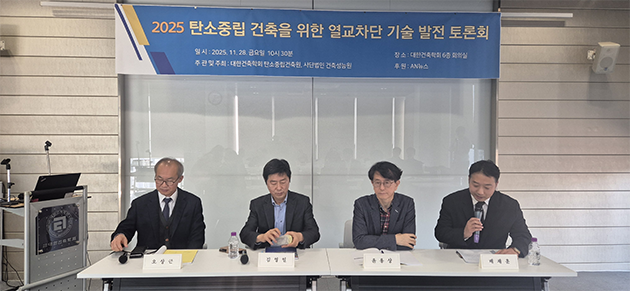
Sang-geun Oh, President of the Korea Construction Safety and Environment Practice Association, stated that as the importance of thermal break technology continues to grow, its inclusion in the standard specifications for building construction should be considered. He noted that even when thermal break technology is incorporated into a building design, practical implementation remains difficult without clear construction standards. Establishing standardized construction methods would help ensure consistency between design and construction while also supporting more reliable assessments of economic feasibility.
Professor Young-il Kim explained that even when a building envelope is well insulated, heat loss becomes concentrated at points with high thermal conductivity. Projecting elements such as balconies can create a fin effect, significantly increasing heat loss. He also emphasized the importance of establishing fair and objective performance assessment standards to ensure the proper application of thermal break technology.
Yong-sang Yoon, Director of the Operational Carbon Center, noted that the current ECO2 thermal bridge adjustment values show only a small difference between interior and exterior insulation systems, potentially understating the actual impact of thermal bridging. He therefore called for more appropriate assessment criteria. He also pointed out that overly complex thermal bridge length calculations can limit practical implementation and suggested institutional improvements to reduce this burden.
The forum reaffirmed that addressing thermal bridging extends beyond energy savings and is directly linked to improving building quality, protecting occupant health, and ultimately achieving carbon neutrality. Participants agreed that the institutional adoption of thermal break technology should be pursued in stages, including the establishment of performance assessment standards and its incorporation into the ECO2 program.
▼ Watch the Related Video
https://www.youtube.com/watch?v=K80MV0s_SwI&list=PLBtx4e502T4ke51g87Ox8E_HmopL_J1_V
▼ View Related Articles
https://www.kharn.kr/news/article.html?no=29397